
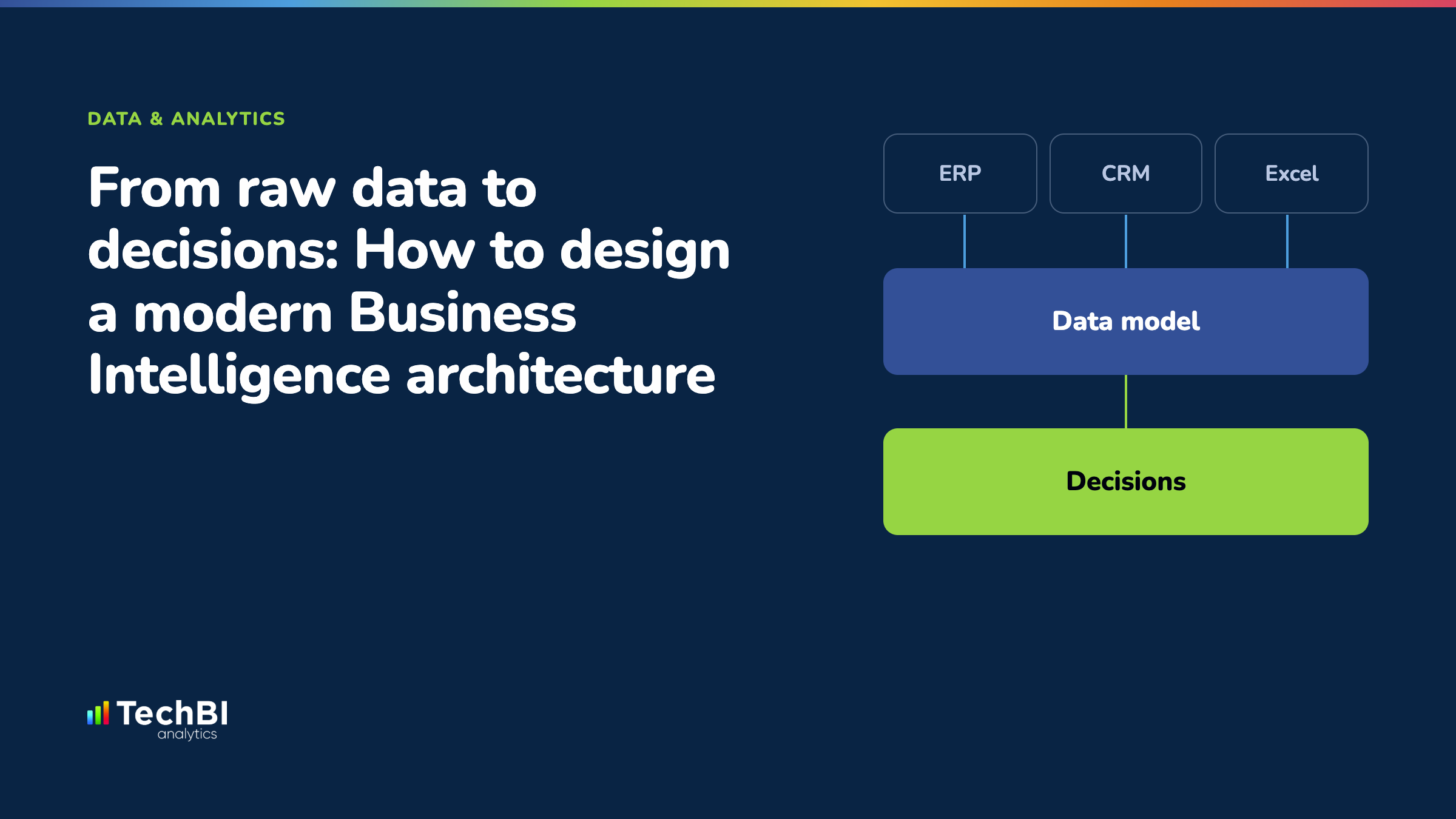
How to Design a Modern Business Intelligence Architecture
To scale a B2B operation, a modern Business Intelligence (BI) architecture is the technical structure that centralizes, processes and transforms a company's scattered data into actionable strategic insight.
The goal of this architecture is to eliminate information silos and integrate ETL/ELT processes so leadership can make decisions based on accurate predictions and real-time reports instead of gut feeling.
Many companies make the mistake of buying licenses for visualization tools, thinking that will solve their analytics problems. But flashy charts connected to disorganized or slow databases are like putting a Ferrari body on an old car's engine.
Below, we break down the essential components for designing a data infrastructure that truly keeps pace with your business growth.
1. The big operational problem:
The chaos of data silos. As a company grows, information becomes scattered. Sales uses a CRM (like Salesforce or HubSpot), Finance an ERP (like SAP), Operations endless spreadsheets, and Marketing its own ad platforms.
This creates three critical headaches for any Chief Operating Officer (COO) or CFO:
- Inconsistent reporting: Sales says 100 units were sold, but Finance shows 80 invoiced. Who's right?
- Wasted time: Entire teams spend hours every week building manual Excel reports that are outdated by the next day.
- Lack of scalability: Data processing slows down, servers get overloaded and operations stall.
2. The pillars of a modern BI architecture
To solve this chaos, the data architecture must be designed around three fundamental technical concepts that ensure speed, security and scalability:
Data Warehouse vs. Data Lakehouse
| Feature | Traditional Data Warehouse | Modern Data Lakehouse (TechBI) |
|---|---|---|
| Data types | Structured data only (traditional SQL tables). | Structured, semi-structured and unstructured (videos, logs, PDFs). |
| Storage cost | High: Storage is rigidly coupled to compute power. | Very low: Cloud-native storage decoupled from processing. |
| Main use cases | Static historical reporting and basic Business Intelligence. | Modern real-time BI, Data Science, Machine Learning and enterprise GenAI. |
| Speed | Slow: Rigid ETL processes that must transform data before loading it. | Ultra fast: ELT architecture that processes gigabytes in seconds while lowering costs. |
| Governance and AI | Limited to access controls of traditional relational databases. | Centralized, ideal for global data audits and secure AgentOps deployment. |
Traditionally, companies used a Data Warehouse to store structured data. Today, leading organizations are moving to a Data Lakehouse, a hybrid architecture that combines the storage flexibility of a Data Lake (for raw data, images, logs) with the management, quality and governance capabilities of a Data Warehouse.
Modern platforms like Databricks and Snowflake are leading this transition.
Efficient ETL and ELT processes
Integration pipelines are used to move data from source applications into your centralized repository.
While ETL (Extract, Transform, Load) processes data before storing it, the modern ELT approach (Extract, Load, Transform) leverages cloud processing power (like Azure or Google BigQuery) to load raw data first and transform it at high speed based on business needs.
Data Quality and Governance
A modern architecture is useless if the data is duplicated or corrupted. Implementing governance policies ensures clear rules for access, information security and record cleansing, so the final data is 100% reliable.
3. From infrastructure to the screen: The business impact
Analytics Maturity Curve
Strategic Impact on B2B Business
Analytics Maturity Curve vs. Business Value
Once data is unified and clean in the cloud, it's time to put it to use. This is where the market's leading visualization tools come in, such as Power BI, Tableau or Qlik. By connecting these tools to a solid architecture, the company moves from reactive to proactive analytics:
[Sources: ERP, CRM, APIs] ➔ [ELT Process] ➔ [Central Data Lakehouse]➔ [Predictive Models / BI] ➔ [Business Decisions]
- Automated interactive dashboards: Reports that update themselves to monitor the company's financial or logistics health in real time.
- Data democratization (Data Literacy): Enabling department managers to build their own reports without constantly depending on the IT team.
- Predictive models and demand forecasting: Laying the groundwork for enterprise Artificial Intelligence, anticipating market trends or stockouts.
Conclusion:
Is your current infrastructure ready for the next level?
Designing a modern BI architecture isn't a software expense; it's a structural investment to protect and accelerate your company's operations.
If your team is still making decisions based on manual reports or fragmented data, you're losing ground to competitors that already operate in real time.
At TechBI, we specialize in data consulting, cloud architecture design and the integration of custom analytics solutions for companies across Spain, Latin America and North America.
Lo que suelen preguntarnos
How long does it take to implement a modern Business Intelligence architecture?
A baseline implementation (MVP) that integrates the main data sources usually takes 8 to 12 weeks, depending on the complexity of the company's software ecosystem and the current state of its data.
What's the difference between a Data Warehouse and a Data Lakehouse?
A Data Warehouse only stores structured, processed data for historical reporting. A Data Lakehouse combines that capability with low-cost storage of semi-structured and unstructured data, making it possible to run advanced analytics and Artificial Intelligence (GenAI) models on a single platform.
Do we need to migrate our entire infrastructure to the cloud to do BI?
It's not mandatory, but it's highly recommended. A modern architecture can connect to on-premise systems in a hybrid way through APIs and secure integrations, although centralized cloud processing (Azure, AWS or Google Cloud) lowers operating costs and dramatically improves speed.