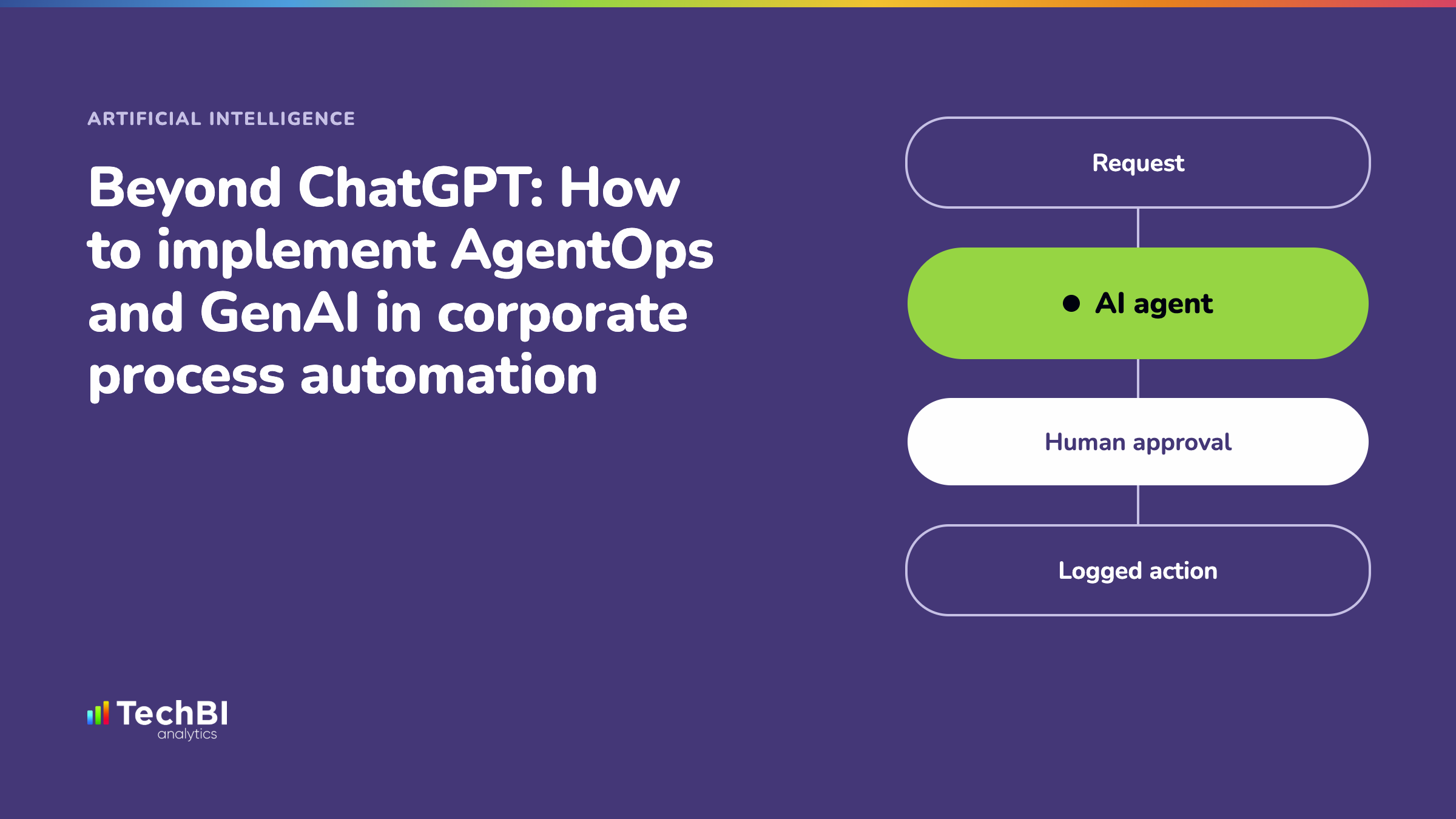
Beyond ChatGPT: How to Implement AgentOps and GenAI in Your Company
In B2B business environments, AgentOps (AI Agent Operations) is the set of practices, tools and development methodologies used to monitor, evaluate and manage autonomous Generative AI (GenAI) agents in production safely and at scale.
Unlike traditional chatbots, an AgentOps-based system doesn't just answer questions: it runs complex workflows, makes logical decisions and interacts autonomously with the APIs of your internal systems (ERP, CRM or databases) under strict corporate governance policies.
2023 was marked by the mass adoption of language-based productivity tools. But in today's corporate ecosystem, leading companies have found that relying on manual chat windows creates isolated bottlenecks.
The real return on investment (ROI) of Artificial Intelligence is unlocked when large language models (LLMs) become autonomous digital workers able to automate critical operations end to end.
1. The technical leap: From AI that answers to AI that executes
A common mistake among company leaders is confusing an integrated GenAI solution with simple automated replies (a customer service chatbot). Today's technology splits implementation into two approaches:
- Passive Models (traditional chatbots): They wait for a human command (prompt), process information in isolation and return text. They carry a high risk of hallucination and have no direct impact on the operational database.
- Autonomous Agents (TechBI Ecosystem): They are given a business goal (for example: "Reconcile this month's rejected invoices"). The agent analyzes the context, breaks the problem into subtasks, queries external systems through APIs (like SAP or Salesforce), validates data quality and executes the final action autonomously.
2. What is AgentOps and why is it the standard your CTO demands?
Launching an AI agent into a company's production environment without oversight is an unacceptable operational risk. Just as software engineers use DevOps and data scientists use MLOps, advanced generative AI requires AgentOps.
This technical methodology solves three critical challenges in corporate infrastructure:
Why does your infrastructure need AgentOps?
Isolated experimentation vs. secure corporate operations
- Financial black box: No control over the tokens LLMs consume. Risk of massive, unexpected spikes in the cloud bill.
- Invisible hallucinations: If the agent makes a wrong decision with a customer, IT has no way to audit why the prompt failed.
- Security gap: No perimeter controls (guardrails). Sensitive corporate ERP data can be exposed.
- Financial telemetry: Real-time monitoring of infrastructure cost per agent, optimizing model usage (GPT/Claude).
- Traceability (Chain of Thought): Detailed logs that store the AI's logical decision tree, enabling instant audits.
- Governance and secure perimeter: Containment layers that validate actions and control API permissions before they reach your systems.
Cost and Latency Monitoring
Advanced models (like GPT-4, Claude or open-source architectures) charge by volume of data processed (tokens). AgentOps tracks each agent's exact consumption in real time to avoid surprises on your cloud bill (Azure, AWS or Google Cloud).
Debugging and Traceability (Chain of Thought)
Traceability Flow: Decision Audit (Chain of Thought)
If an agent makes a wrong decision (for example, rejecting credit for a customer in financial services), AgentOps records the logical decision tree the model followed. This makes it possible to audit the process end to end and correct the base instructions (system prompts).
Security and Hallucination Control
Security Flow: Hallucination and Permission Mitigation
It sets technical guardrails. If the model generates a response outside corporate security parameters or tries to access data it doesn't have permission for, the system automatically blocks the action before it affects operations.
3. Anatomy of a Corporate Autonomous Agent
To understand how this technology integrates without putting your infrastructure at risk, we modeled the logical processing structure of a modern agent connected through APIs:
GenAI Agent Operating Flow (AgentOps)
Conclusion: Stop experimenting and start automating safely
Generative Artificial Intelligence is no longer an experimental tool for companies; it's the new engine of operational efficiency. Implementing autonomous agent architectures under AgentOps methodologies ensures your business drastically reduces operating costs while keeping full control of your data and business workflows.
At TechBI, we design Artificial Intelligence solutions for businesses, automate complex B2B processes and build AgentOps and MLOps policies to ensure your AI models run with maximum accuracy across Spain, the United States and Latin America.
Frequently asked questions
Is it safe to connect AI agents to my company's databases?
Yes, it's completely safe as long as it's implemented on an isolated corporate cloud architecture with data governance. Agents developed by TechBI don't train public models with your data and operate under advanced encryption protocols, interacting with your existing systems in a controlled way only through authorized APIs with limited permissions.
What's the difference between traditional automation (RPA) and AI Agents?
Traditional automation (RPA) follows fixed, rigid rules; if an invoice's format changes by a millimeter, the system breaks. GenAI-based AI Agents understand context: they can read an email written in a thousand different ways, interpret complex unstructured PDF files and make adaptive logical decisions in unexpected situations.