What Is MLOps and Why Does Your Company Need It If You Use AI?
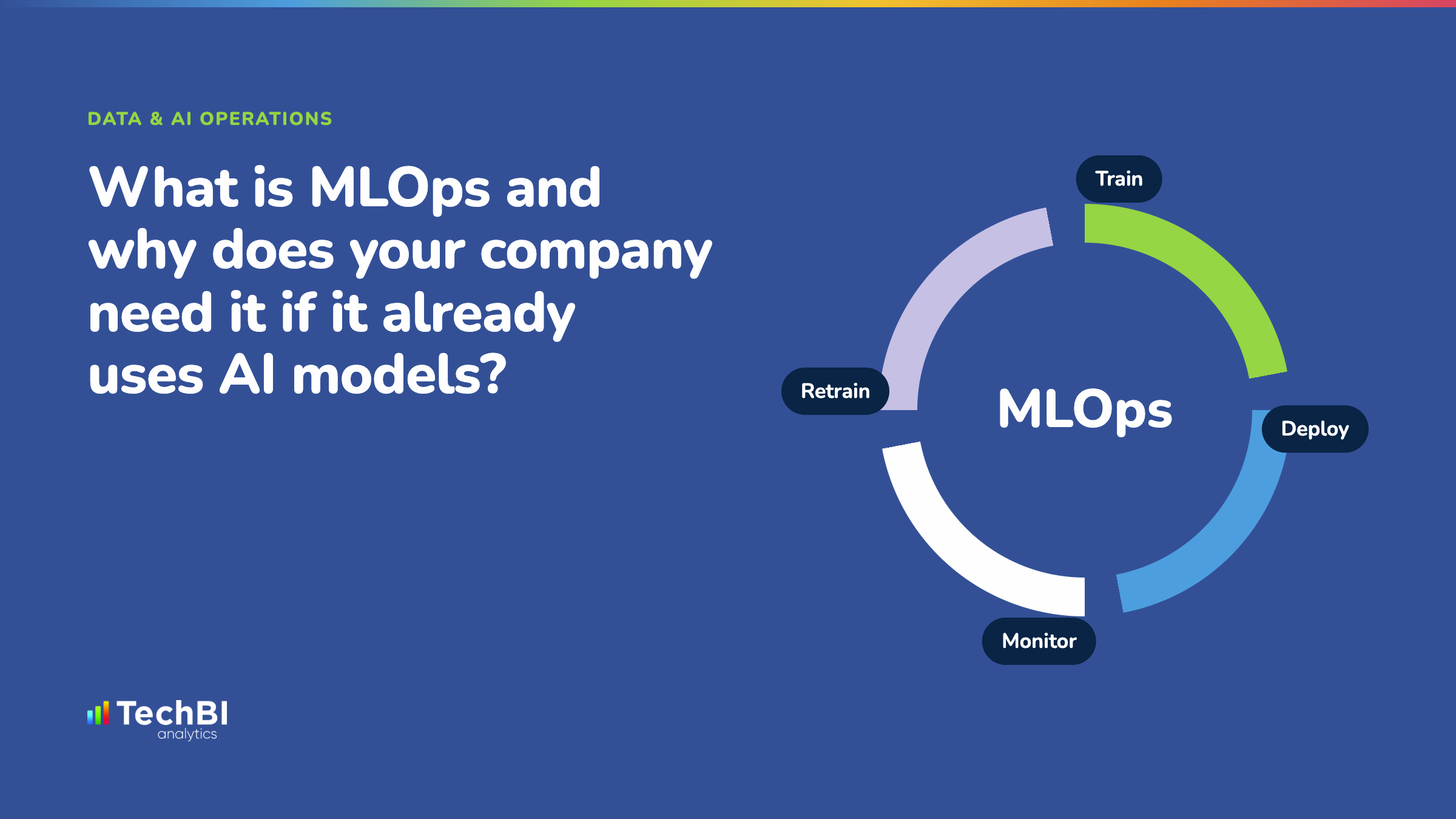
For organizations deploying Artificial Intelligence, MLOps (Machine Learning Operations) is the set of practices, methodologies and technical tools that automate and standardize the entire lifecycle of Machine Learning models in production environments.
Just as DevOps revolutionized traditional software development, MLOps brings together data science, data engineering and cloud infrastructure (like Azure or AWS) to ensure predictive algorithms, recommendation systems and GenAI models are trained, deployed, monitored and recalibrated continuously, securely and efficiently under strict corporate governance policies.
Going from an Artificial Intelligence model that works in a controlled way on a data scientist's laptop to a system that makes thousands of automated decisions per second in your company's backend is a complex leap.
Without a robust MLOps structure, models tend to degrade quickly in production because of changes in real market behavior, a technical phenomenon known as Data Drift.
1. The AI lifecycle and the hidden pain of "Model Decay"
Many technology leaders make the mistake of assuming that deploying a predictive model is a one-time milestone: it's built, uploaded to the cloud and left running forever. But in the real world, data changes constantly.
If your Machine Learning model (for example, a risk-scoring model or your supply chain's demand forecasting model) doesn't have MLOps, your infrastructure will immediately face three critical problems:
- Data Drift: The data the model was trained on no longer reflects current market reality, so the algorithm's predictions quietly lose accuracy month after month.
- No automated retraining: Updating the model with fresh data becomes a manual, slow and error-prone task that eats up hundreds of hours of your IT team's time.
- Operational black boxes: No technical dashboards measuring the model's response latency, cloud infrastructure usage or per-second transaction compute costs.
2. The essential components of a bank-grade MLOps infrastructure
To ensure the stability and maximum return of your enterprise Artificial Intelligence investments, TechBI designs and integrates MLOps architectures built on three modern data engineering pillars:
Automated CI/CD Pipelines for ML
Traditional development uses Continuous Integration and Continuous Deployment (CI/CD) for code. In MLOps, CI/CD expands to automate not only code, but also data retraining and the model's mathematical validation before it goes to production, without stopping the service.
Model Registry and Storage
A centralized, secure repository (like MLflow or Azure Machine Learning) that works as a "version history" for your AI algorithms. If a newly retrained model behaves abnormally or unstably in production, the system can instantly roll back to the previous stable version in milliseconds.
Continuous Monitoring and Perimeter Alerts
Advanced telemetry monitors the model's health 24/7. The system measures the real accuracy of predictions against business results and sends automatic alerts to the engineering team as soon as it detects the first signs of algorithm degradation or critical spikes in token costs.
3. Deployment Pipeline: With MLOps vs. Without MLOps
To understand the software's operational flow and how the performance of your predictive models is protected in the enterprise backend, we mapped the operating cycle under both technical approaches:
AI Model Lifecycle in Production
Long-term operational stability compared
• The model is deployed once, rigidly.
• Model Decay: The algorithm loses accuracy every day due to market Data Drift.
• Slow manual retraining that holds back the technical team.
• High risk of critical system failures without log telemetry.
• Automated retraining pipelines with fresh data.
• 24/7 accuracy monitoring of business variables.
• Model Registry (MLflow): Secure versioning and automatic rollbacks in milliseconds if the AI fails.
• Real-time telemetry to keep cloud costs under control.
Conclusion: Scaling your Artificial Intelligence takes engineering, not intuition
Deploying Machine Learning models without an MLOps strategy is like buying a fleet of delivery trucks without a garage to handle preventive maintenance.
Designing an automated infrastructure is the only direct way to protect your algorithms' accuracy, secure your technology ROI and ensure Artificial Intelligence is a reliable, secure engine for your company's operations.
At TechBI, we specialize in advanced data engineering, deploying intelligent solutions and building MLOps, DataOps and AgentOps operating policies for companies in Spain and Latin America.
Frequently asked questions
When exactly should a company implement MLOps?
An organization should adopt MLOps practices the moment it decides to move its first predictive or AI model out of the lab test environment (local notebooks) into the company's real production environment, where the system interacts directly with customer-facing applications, critical APIs or the company's accounting databases.
What's the difference between MLOps and traditional DevOps?
Traditional DevOps focuses only on the lifecycle of static software code. MLOps adds a higher level of complexity, because it has to continuously manage and automate three live, dynamic variables at the same time, each changing independently: the application code, the Machine Learning algorithms and the massive flows of business data and inputs.