Custom Software vs. Off-the-Shelf Software: Which Scales Your B2B Operation Better?
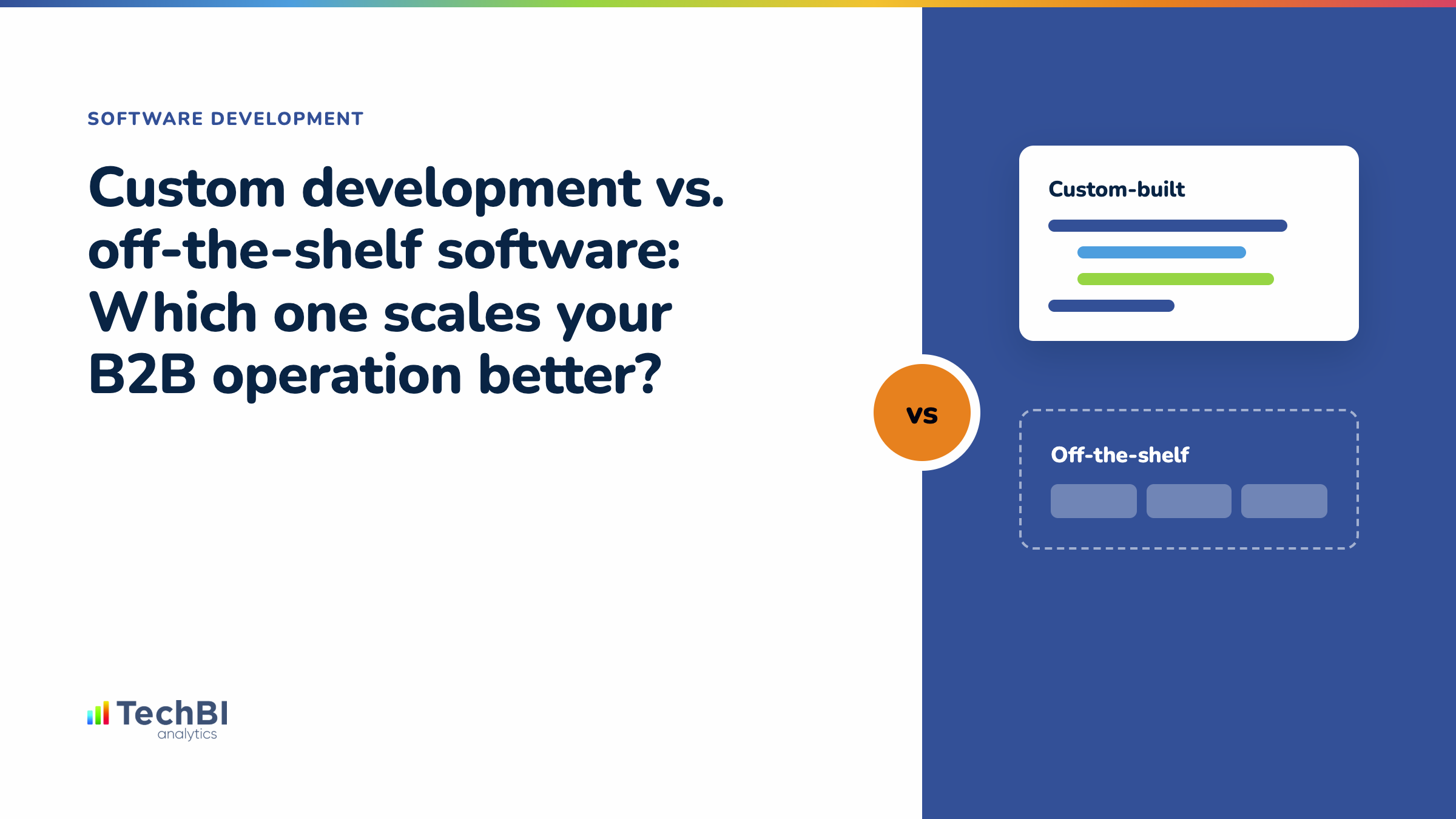
For growing companies, the choice between custom development and off-the-shelf software depends on how customized their core processes are: off-the-shelf software is ideal for standard functions and fast rollouts, while custom development is the strategic solution to optimize complex operations, integrate existing systems through APIs and scale without hidden licensing costs.
When a B2B organization sees a jump in operational volume, its existing software infrastructure becomes the first bottleneck. Many companies fall into the trap of adapting their business model to the limitations of mass-market commercial software, instead of making technology work for them.
Below, we analyze the critical factors that determine when to make the leap to a 100% custom software solution.
1. The ceiling of off-the-shelf software (rigid SaaS)
Ready-to-use platforms (like certain general-purpose commercial ERPs or CRMs) are excellent in early stages. But as operations become more sophisticated, the "seams" start to show:
- Lack of flexibility: Changing a field or creating a specific workflow requires bureaucratic processes or is simply impossible.
- The licensing trap: The more users or transactions you process, the more expensive the platform gets. Your business success becomes a financial penalty.
- Disconnected systems: The logistics software doesn't talk to the finance software, forcing the team to enter data manually or duplicate it in spreadsheets.
2. Strategic advantages of Custom Development
Investing in proprietary software designed specifically for your business offers three immediate competitive advantages:
Full integration through robust APIs
Ecosystem Connected through APIs
Automated, real-time data flow with no information silos
Modern custom development isn't about reinventing the wheel, but about intelligently connecting your ecosystem. It lets you build integration layers through custom APIs to connect your current ERP with payment gateways, partner systems or logistics automation platforms, eliminating information silos.
Operational scalability and cloud architectures
Elastic Scalability Console (Cloud)
Auto-scaling simulation during operational demand spikes
*When the operational peak ends, these servers shut down on their own. You pay $0 for them the rest of the month.
Custom software is designed with future load in mind. Using modern cloud infrastructure (like Azure or AWS), the system can automatically scale its resources during demand spikes without degrading the user experience or halting operations.
Zero per-user costs
Licensing Costs vs. Custom Development Simulation
How your team's growth impacts the annual technology budget
While mass-market models penalize the success and growth of your headcount, custom software development with TechBI becomes an intellectual property asset owned exclusively by your company, stabilizing your operating budget over the long term.
Unlike the traditional SaaS model, custom software is an asset of your company. You can add 10 or 1,000 employees to the platform without multiplying your monthly bill, so the marginal cost of operational expansion trends toward zero.
3. Operational Decision Matrix
To help you see which path to take based on the current state of your infrastructure, we put together this quick diagnostic matrix:
When should you choose each option?
Choose it if your company faces this scenario:
- Your processes are 100% standard (e.g., general accounting or basic invoicing).
- You need to implement the solution in less than a week.
- The user team is small and licensing costs don't affect cash flow.
Choose it if your company faces this scenario:
- Your competitive advantage lies in unique operational processes no commercial software can replicate.
- You need to integrate multiple existing platforms (CRM, ERP, supplier systems) through APIs.
- Your user base keeps growing and SaaS licensing costs are holding back your ROI.
Conclusion: Technology should adapt to your operation, not the other way around
Off-the-shelf software is an excellent tactical tool, but custom development is a scaling strategy. If your team spends more time looking for workarounds to keep the current system running than optimizing the business, it's time to design a definitive solution.
At TechBI, we build custom software, automate complex processes and integrate critical platforms to turn technology into the engine of your operational growth across Spain, Latin America and the United States.
Frequently Asked Questions
Is custom software development more expensive than commercial software?
The initial investment in custom development is usually higher than the monthly fee for off-the-shelf software. But in the medium to long term (12 to 24 months), custom software delivers a higher Return on Investment (ROI) by eliminating recurring per-user licensing costs and the inefficiencies of manual processes.
How long does it take to develop a custom software solution?
A working Minimum Viable Product (MVP) is usually developed within 12 to 16 weeks. This lets you test the business-critical features quickly and then iterate or add modules progressively without slowing down day-to-day operations.
What about support and maintenance for custom software?
Unlike mass-market software, where you depend on global support tickets, custom development includes a specialized support and preventive maintenance plan. This ensures security patches, API updates when external systems change and continuous code optimization as the company evolves.